
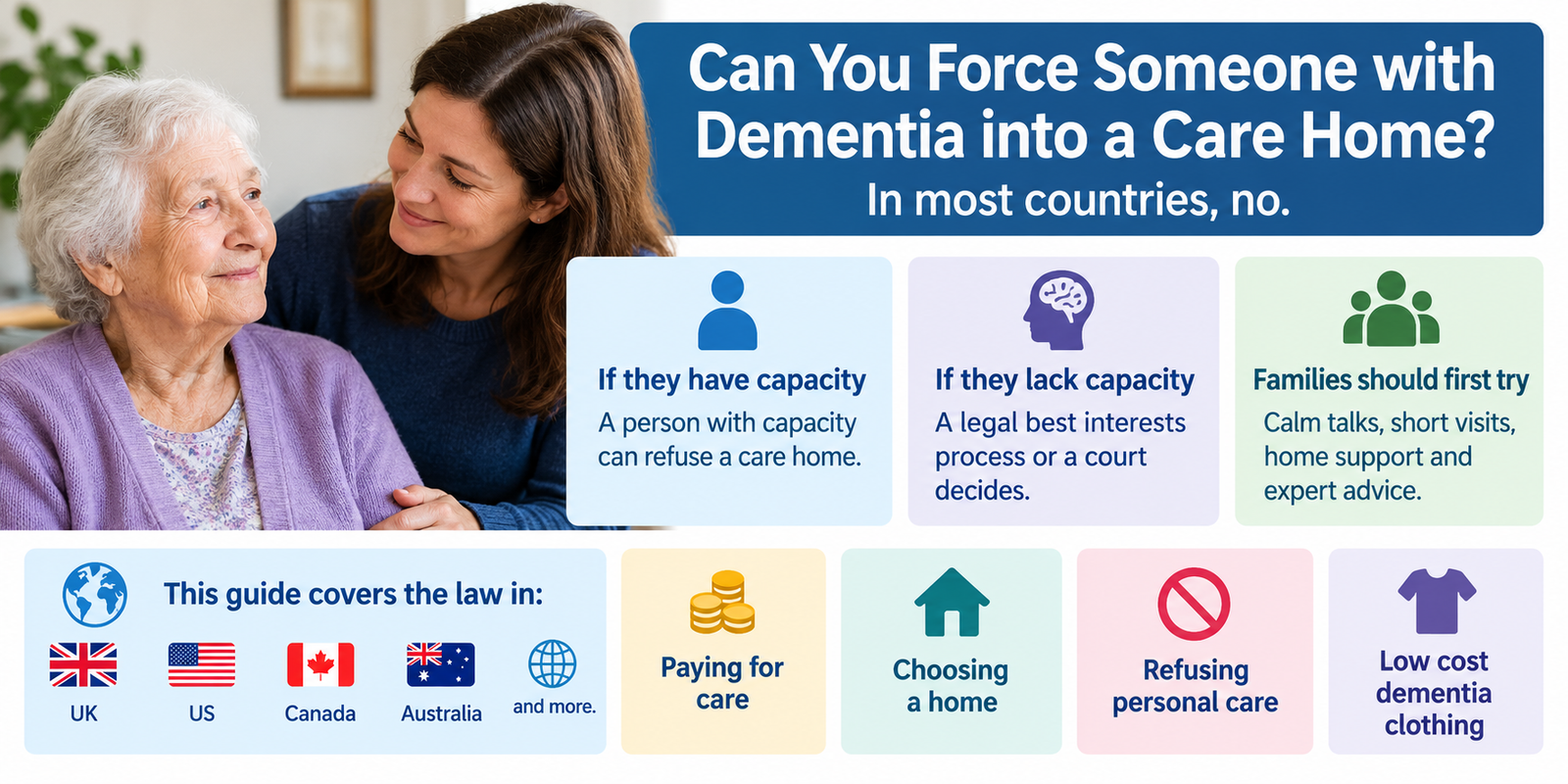
Summary: Can you force someone with dementia into a care home? In most countries, no. A person with capacity can refuse. If they lack capacity, a legal best interests process or a court decides. Families should try calm talks, short visits, home support and expert advice first. This guide covers the law in the UK, US, Canada, Australia and more. It also explains paying for care, choosing a home, refusing personal care and low cost dementia clothing.
Can You Force Someone With Dementia Into a Care Home?
Many families ask if they can force someone with dementia into a care home. It is a painful question, and the answer is rarely simple. However, one point is clear. Adults keep the right to make their own choices while they have capacity. In my ten years as a dementia carer, I have met many tired and frightened families at this point. So this guide explains the law, your options and calmer ways forward.
Why Does Someone With Dementia Refuse a Care Home?
Fear, Confusion and Lack of Insight
Home holds memories and routine. Because dementia affects memory, a new place can feel like a trap. Also, many people cannot see that they need help. Doctors call this anosognosia. The person truly believes they are coping well. As a result, arguing with facts rarely works.
Why a Parent May Refuse to Leave Home
Some parents fear losing independence. Others worry about cost or being a burden. Some fear that a care home is a place to die. Therefore, ask what scares them most. Their answer often shows you where to start.
Dementia Patient Refusing Help and Losing Independence
Refusing help is often a way to keep control. So offer small choices, such as which day a carer visits. Even small choices protect dignity. In addition, praise what they can still do.
Can You Legally Force Someone With Dementia Into a Care Home?

Can You Force Someone With Dementia Into a Care Home Without Consent?
In most countries, no. A person with capacity can say no, even if the choice looks unwise. However, if they lack capacity, others may decide for them. Even then, the law sets clear steps. No relative can simply move them.
When Can Someone Be Moved Without Their Agreement?
Sometimes a move happens when a person lacks capacity and is at real risk. For example, this may follow a hospital stay or a serious fall. Usually the decision is made in their best interests. Family, doctors and social workers all take part. Also, the law expects the least restrictive choice first. So home support is usually tried before a move.
Who Makes Decisions When Someone Lacks Capacity?
It depends on where you live. Often it is an attorney or a guardian with legal power. Otherwise, professionals or a court decide. In every case, the aim is safety and the person’s best interests.
Sort Out Legal Papers Early
Early planning avoids many fights later. While capacity remains, the person can name someone they trust to decide for them. In England and Wales, this is a health and welfare Lasting Power of Attorney. A property and finance document does not cover care home decisions. Also, the document must be registered before it can be used.
If no papers exist and capacity is gone, a court may need to step in. In England and Wales, this is the Court of Protection. It can be slow and costly. Therefore, do not wait.
Mental Capacity Assessment for Dementia

What Is a Mental Capacity Assessment?
Capacity is about one decision at one time. For example, someone may choose their clothes but not where to live. A doctor, nurse or social worker usually carries out the assessment.
How Capacity Affects Care Home Decisions
First, they check if the person understands the choice. Then they check if the person can hold it in mind and weigh it up. Finally, they check if the person can share a view. The law also says to assume capacity unless proven otherwise. An unwise choice does not prove a lack of capacity.
What Happens When Someone Lacks Capacity?
The decision maker must act in the person’s best interests. They must consider past wishes, values and feelings. They should also speak to family and friends. If nobody suitable exists, many places provide an independent advocate.
How Families Can Support Decision Making
Capacity can change from day to day. So ask for the assessment at their best time of day. Many people are clearer in the morning. Also, use short sentences, photos and a quiet room. Give time to answer. Finally, write down what they say, because it helps later.
How Countries Handle Forced Dementia Care
Legal words differ between countries, so do not treat them as the same.
UK. In England and Wales, the Mental Capacity Act 2005 applies. Staff must assume capacity and act in best interests. Deprivation of Liberty Safeguards cover people who cannot leave a care home freely. However, a Supreme Court ruling in June 2026 changed how this is tested. Therefore, ask your council for current guidance. Scotland uses the Adults with Incapacity Act, and Northern Ireland has its own Mental Capacity Act.
USA. Rules vary by state. A court appointed guardian may arrange care. Yet many states need court approval for a locked unit. Also, a power of attorney only helps if it was signed while the person had capacity. An elder law attorney can explain local rules.
Canada. Each province has its own law. Usually a substitute decision maker, often a family member, acts when capacity is lost. Placement into long term care is often arranged through the local health authority.
Australia. State tribunals appoint guardians and approve accommodation decisions. Restrictive practices, such as locked doors, have strict rules. Aged care assessments are arranged through My Aged Care.
Netherlands. The Care and Coercion Act allows involuntary care only under set conditions with checks.
New Zealand. The PPPR Act lets the Family Court make personal orders about where someone lives.
Europe and Japan. In Germany, a guardianship court approves closed placements. France uses tutelle, a legal protection system. Italy uses a support administrator chosen by a guardianship judge. In Japan, the Family Court appoints an adult guardian.
Laws change often. So speak to a local lawyer or dementia charity before you act.
What to Do When a Relative Refuses to Move
How to Discuss Moving Without Causing Distress
Choose a calm time of day. Avoid late afternoon, when confusion can rise. Listen first, and do not argue. For example, say “Shall we just look together?” instead of “You must move.” Also, agree with their feelings, even if the facts are muddled.
How to Arrange Visits and Gradual Introductions
Start small. Try a lunch visit, then a day visit, then a short respite stay. This is also cost effective. Many homes offer trial stays, and some areas fund respite after a needs assessment.
How to Choose a Good Care Home
Visit more than once. Go at different times, including mealtimes. Then watch how staff speak to residents. Ask about dementia training and how staff handle distress. Also look for safe gardens, clear signs and calm noise levels. Finally, ask if residents can bring their own furniture.
When to Ask Professionals for Help
Ask the GP first. Then contact social services for a care needs assessment. Carers can often ask for their own assessment too. Also, dementia nurses and helplines can guide difficult talks. Do this early, because crisis decisions are harder.
How to Prepare for a Difficult Transition
Bring familiar items, such as photos, a favourite chair and bedding. Label all clothes with their name. On moving day, keep goodbyes short and warm. Then visit often in the first weeks. Settling in can take time. So expect some sadness and tell staff about daily habits.
Dementia Resistance to Care and Refusing Personal Care
Why Someone With Dementia Resists Care
Refusing a wash or dressing is very common. Often the cause is fear, pain, cold or feeling rushed. Being helped by a stranger can also feel frightening. So slow down and explain each step gently.
When Refusal May Be Caused by Pain or Illness
A sudden change in behaviour needs a check. First, ask a GP to rule out pain, infection or constipation. Also check hearing, sight and sore feet. In many cases, treating the cause ends the refusal.
Dementia Clothing That Reduces Stress
The right clothing for the elderly protects dignity and saves time. Easy wear clothing for the elderly with dementia often has soft stretch fabric and elastic waists. Large buttons or Velcro also help.
Alzheimers clothing with back opening tops suits stiff arms. Assisted clothing for the elderly with dementia lets a carer dress someone without long struggles. Some styles also stop people undressing in public.
Good dementia clothing need not cost much. Here are some practical ideas.
- Buy stretch tops one size larger from a high street shop or charity shop.
- Sew Velcro over buttons for a few pounds.
- Lay clothes out in the order they go on.
- Offer just two choices to avoid confusion.
- Choose non slip shoes with easy fastenings.
- Use plain colours, as busy patterns can confuse.
Live In Care and Other Alternatives to a Care Home
Live In Care for Dementia
Live in care gives one to one support at home. It costs more than visiting carers. However, for couples, it can cost less than two care home places.
Visiting carers help with washing, meals and medicines. For example, a family may start with morning visits and a day centre twice a week. Also, meal delivery and simple safety devices can cut risk.
Respite Care and Short Stays
Respite gives carers a real rest. It also lets the person try a home without a big decision.
When Residential Care May Become Necessary
Sometimes risks at home cannot be managed safely. Examples include wandering at night, repeated falls or carer exhaustion. At that point, involve professionals and keep the person at the centre.
Who Pays for Dementia Care?
Costs vary widely by country. In many places, a financial assessment decides who pays. Some people receive help from their government. Others pay themselves. In the UK, ask your council about funding and NHS Continuing Healthcare. Benefits such as Attendance Allowance may also help. In the US, Medicare usually does not pay for long term custodial care, so ask about Medicaid. Always ask for a written assessment, because it can be challenged.
Dementia Care Crisis Management
What to Do When Someone Refuses Essential Support
Stay calm and try again later. Offer the help in a different way or from a different person. Also tell their GP.
What to Do When Someone Is Unsafe at Home
If someone is in immediate danger, call emergency services. Otherwise, contact their GP or social services the same day. Also, fit door sensors, cooker safety devices and simple locks. As a result, risks fall while you plan.
How to Plan for Future Emergencies
Keep a folder with medicines, legal papers and key phone numbers. Also choose a back up carer. Having a plan lowers stress for everyone.
Looking After Yourself
Guilt is very common for carers. Yet a burnt out carer cannot give safe care. So accept help and join a support group. Also remember that choosing a care home can be an act of love.
Helplines by Country
UK: Alzheimer’s Society 0333 150 3456. USA: Alzheimer’s Association 1 800 272 3900. Australia: National Dementia Helpline 1800 100 500. Canada: Alzheimer Society of Canada 1 800 616 8816, or your provincial society. Please check each number before publishing.
Conclusion
You cannot simply force someone with dementia into a care home. The law protects their rights, and rightly so. However, when capacity is lost, legal routes exist to keep them safe. Start with kind talks, small steps and home support. Also seek professional advice early. With patience, most families find a safe and respectful answer.
Frequently Asked Questions
Can someone with dementia refuse to go into a care home?
Yes, if they have capacity to make that decision. The law assumes capacity unless it is tested and shown to be lacking. If they lack capacity, a best interests process or a court decides.
Can family members force a relative with dementia into care?
No. Family need legal authority, such as guardianship or a valid power of attorney. Many places also need court or professional approval. Moving someone by pressure or trickery can be unlawful.
Can you legally force someone with dementia into a care home in the UK?
Not simply. In England and Wales, a capacity assessment and a best interests decision come first. If the person cannot leave freely, extra legal checks apply. The rules on these checks changed in June 2026, so ask your council.
Who decides when a person lacks capacity?
A trained professional assesses capacity for a specific decision. Then an attorney, guardian or the professionals involved make the decision in the person’s best interests. A court decides when there is no agreement.
What is a mental capacity assessment for dementia?
It is a check of whether the person can make one particular decision. It tests if they can understand, remember, weigh up and share a choice. It is not a test of overall intelligence.
Can capacity change from day to day?
Yes. Dementia often causes good and bad periods. Tiredness, infection and pain can also lower capacity. So professionals should try to assess at the person’s best time.
Does power of attorney let me place my parent in a care home?
Sometimes. It depends on the type of document and the country. In England and Wales, only a health and welfare attorney can make this choice, and only after capacity is lost. Always check with a lawyer.
What if there is no power of attorney and my parent has lost capacity?
Speak to social services and the GP. They can make a best interests decision with you. If there is a dispute, a court may appoint a deputy or guardian. This can take time, so start early.
Why does my parent say nothing is wrong?
Lack of insight is a common part of dementia. The brain may not notice its own changes. So it is not lying or being difficult. Use gentle, practical support rather than proof.
What should I say when my relative refuses to move?
Stay calm and listen to the fear behind the words. Avoid “you have no choice”. Instead, suggest a visit or a short stay. Keep repeating that you are on their side.
How do I arrange a trial stay in a care home?
Ask homes about respite or short stays. Some local authorities or health services fund part of the cost after an assessment. A trial also helps you judge the home.
What should I look for when choosing a care home?
Look for trained, kind staff and calm mealtimes. Check that residents look clean and occupied. Ask about outside space, personal rooms and family visiting. Also read the latest inspection report in your country.
Why does someone with dementia refuse to wash or dress?
Common causes are pain, cold, fear, embarrassment and feeling rushed. They may also not understand what is happening. Explain each step, keep the room warm and protect privacy.
What is the best clothing for someone with dementia?
Choose soft, stretch and easy to fasten clothes. Elastic waists, Velcro and large buttons work well. Back opening styles suit people who need help. Good dementia clothing keeps dignity and independence.
Is adaptive clothing expensive?
It can be, but it does not have to be. Charity shops, larger sizes and simple home changes cut cost. For example, swapping buttons for Velcro costs very little.
Can a person with dementia stay at home safely?
Often yes, with the right support. Visiting carers, day centres, safety devices and family help all count. However, regular reviews matter, because needs change.
What if my relative is unsafe at home but refuses help?
Contact their GP and social services. Ask for an urgent assessment and explain the risks clearly. If the danger is immediate, call emergency services.
How much does dementia care cost?
It varies by country and type of care. Home visits, live in care and care homes all differ in price. Ask for a financial assessment and compare written quotes.
How can I cope with guilt about a care home move?
Guilt is normal and does not mean you did wrong. Many families later find the person is safer and calmer. Talk to a support group, a helpline or your own doctor.
Where can I get help?
Start with the GP, local social services and a national dementia charity. Helplines are free in many countries. Use the list above for your area.
“Get trusted advice on dementia care at home and practical tips for looking after someone with dementia at home-all in one place.”