

Summary: Alzheimer’s disease often begins developing decades before symptoms appear, but around 95% of cases are linked to lifestyle rather than genetics. Regular resistance training, good sleep, blood pressure control, and targeted nutrition, including creatine and omega-3, generally contribute to Alzheimer’s Disease prevention and can meaningfully lower risk.
Women face a higher risk than men, largely tied to hormonal changes. This guide explains what the science says and what you can do about it, wherever in the world you live.
What Is Alzheimer’s Disease Prevention and Why Does It Start So Early?
Alzheimer’s disease prevention is not something to think about only in later life. According to neurophysiologist Louisa Nicola, speaking on The Diary Of A CEO with host Steven Bartlett, the disease quietly begins to take hold in a person’s 30s, long before any symptoms are noticeable. Because the first signs typically do not appear until someone’s late 60s or 70s, the early damage can go unaddressed for decades.

It helps to understand the terms first. Dementia is the umbrella term for a group of conditions that affect memory, thinking, and daily function. Alzheimer’s disease is the most common form of dementia, but it sits alongside other types, such as vascular dementia, dementia with Lewy bodies, frontotemporal dementia, and Parkinson’s dementia. Each has a slightly different cause, though many share overlapping risk factors.
Globally, around 60 million people currently live with Alzheimer’s disease, and that figure is projected to triple by 2050. This means Alzheimer’s disease prevention is not a niche concern. It is a public health issue that touches nearly every family in every country.
Can Alzheimer’s Disease Be Prevented? The Genetics vs Lifestyle Split
So, can Alzheimer’s disease be prevented? For the vast majority of people, the answer appears to be yes. Nicola explains that only around 3% of Alzheimer’s cases are caused directly by inherited genetic mutations that guarantee a person will develop the disease. These mutations are rare and passed down through families in a predictable pattern.
The remaining 95% of cases are linked to lifestyle and environmental factors rather than fixed genetic destiny. That is a significant shift in how we should think about brain health. It means daily habits, built up over years, carry real weight in determining whether someone develops the disease.
What Is the APOE4 Gene and Should You Get Tested?
One gene worth knowing about is APOE4. Unlike the rare mutations mentioned above, APOE4 does not guarantee Alzheimer’s disease. Instead, it raises the risk. Everyone inherits one copy of the APOE gene from each parent, and the gene comes in three main variants, APOE2, APOE3, and APOE4.
Carrying one copy of APOE4 roughly doubles or triples a man’s risk of Alzheimer’s disease. For women, the picture is more serious. One copy raises risk around sixfold, and two copies raise it as much as fifteenfold. This gap is one of several reasons women are disproportionately affected by the disease.
Testing for APOE4 is straightforward. A simple blood test, requested through a GP or physician, can reveal your status. Many people choose to get tested so they can make more informed choices about lifestyle, monitoring, and, where appropriate, treatment options.
Why Are Women More Likely to Get Alzheimer’s Disease?
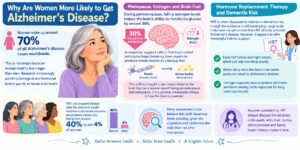
Women make up around 70% of all Alzheimer’s disease cases worldwide. This is not simply because women tend to live longer than men. Research increasingly points to biological and hormonal factors specific to female brain health.
Menopause, Estrogen and Brain Fuel
During perimenopause, falling estrogen levels bring about a striking change in how the brain gets its energy. Nicola points to research showing a roughly 30% reduction in the brain’s ability to metabolise glucose, its main fuel source, during this transition. In response, support cells in the brain called astrocytes begin breaking down myelin, the protective coating around nerve fibres, to produce ketone bodies as a backup fuel.
This shift is thought to be closely linked to the brain fog that many women report during perimenopause and menopause. It is not simply tiredness or stress. It reflects a genuine, measurable change in how the brain is powered.
Hormone Replacement Therapy and Dementia Risk
Hormone replacement therapy, or HRT, is frequently discussed in relation to dementia risk, though the evidence is still developing. Large scale randomised trials proving that HRT directly prevents Alzheimer’s disease do not yet exist. However, HRT appears to offer meaningful indirect support.
By easing hot flashes and night sweats, HRT can significantly improve sleep quality, and better sleep supports the brain’s ability to clear waste products linked to Alzheimer’s disease, which is covered in more detail below. Estrogen also supports muscle protein synthesis and bone density, both of which play a role in long term brain health.
It is worth noting that HRT use dropped sharply after the Women’s Health Initiative study raised concerns about breast cancer risk, falling from around 40% of women to just 4%. Many researchers now believe this shift deserves fresh scrutiny, given the cognitive and cardiovascular risks that rise after menopause.
Anyone considering HRT should discuss the decision individually with their doctor, since personal and family health history matters here.
Cognitive Reserve Explained: Why Some People Age Sharper Than Others
Have you ever noticed that some people in their 60s or 70s remain razor sharp, while others of the same age struggle with memory and word finding? This difference often comes down to a concept called cognitive reserve.
Cognitive reserve is the brain’s stored capacity to withstand stress and damage. It works a little like physical fitness. Someone with a high level of cardiovascular fitness has more reserve to draw on during illness or physical strain.

The brain works in a similar way. Two people can have a similar amount of underlying disease pathology, yet one retains full cognitive function while the other does not, purely because they have built up more reserve over time.
Reserve is built through the connections between brain cells. Every new thought, skill, or piece of information forms or strengthens these connections. Interestingly, one study found that handwriting and reading were linked to preserved cognitive function at age 75. By contrast, passive scrolling on social media appears to train the brain to seek short bursts of dopamine rather than sustained focus, which does little to build reserve.
Best Exercises for Alzheimer’s Prevention: Types, Weight and Frequency
When it comes to Alzheimer’s disease prevention, exercise stands out as one of the most well supported interventions available. The evidence points to three distinct types of training, each offering a slightly different benefit for the brain, so a well rounded routine should include all three rather than relying on just one.
1. Resistance training (2 to 3 sessions a week)
This means lifting weights, whether with a barbell, dumbbells, resistance bands, or bodyweight movements like squats and lunges. Compound exercises that work several muscle groups at once, such as the deadlift, squat, and overhead press, are particularly effective because they engage large amounts of muscle in a single movement.
2. High intensity interval training, or Zone 5 (once or twice a week)
This involves short bursts of near maximum effort, followed by rest. It can be done on a stepper, bike, rower, or simply on foot, and does not require a long session to be effective.
3. Moderate aerobic exercise, or Zone 2 (once or twice a week)
This is steady, lower intensity movement, such as brisk walking, jogging, swimming, or cycling, done at a pace where conversation is still possible but noticeably harder than resting.
How to Measure the Weight You Should Lift
For resistance training to benefit the brain, research suggests the weight needs to be genuinely challenging. The SMART trial and related studies point to training at around 80% of a person’s one repetition maximum, meaning 80% of the heaviest weight you could lift for a single, safe repetition of a given exercise.
In practice, this usually means a weight you can lift for around six to eight repetitions before your muscles are close to failure, rather than a light weight you could lift twenty or more times. If you are new to resistance training, it is worth working with a qualified trainer or physiotherapist first to establish safe form and an accurate starting weight, since lifting heavy with poor technique carries injury risk.
If calculating a precise one repetition maximum feels daunting, a simpler guide is the rate of perceived exertion scale. Aim for a weight that leaves you feeling you could manage only one or two more repetitions with good form once you finish a set.
How Often You Should Train for Brain Health
Frequency matters as much as intensity. In the SMART trial, people with mild cognitive impairment who completed resistance training two to three times a week not only preserved their cognitive function, but they improved their processing speed and fluid intelligence, and showed slower loss of grey matter.
For high intensity interval training, once or twice a week appears sufficient. One well known protocol, the Norwegian 4×4, involves four minutes at 90 to 95% of maximum heart rate, followed by four minutes of rest, repeated four times.
HIIT for the brain – A separate study led by cardiologist Dr Ben Levine found that combining one weekly high intensity session, one longer moderate aerobic session, and one resistance training session, around four hours of exercise a week in total, was enough to remodel the heart and reverse its biological age by around 20 years over two years.
Why Resistance Training Benefits the Brain
The likely mechanism behind resistance training’s brain benefits involves myokines, signalling molecules released from muscle during exercise, particularly when lifting at higher intensities. These molecules travel to the brain and support the growth of new neurons in the hippocampus, the brain’s memory centre and the first region to shrink in Alzheimer’s disease.
One myokine, irisin, helps activate brain derived neurotrophic factor, commonly known as BDNF, a key growth factor for new brain cells. Another, interleukin-6, has anti-inflammatory effects in the brain when released through exercise, and has also been linked to reduced growth of certain cancers, including breast, colon, and prostate cancer.
Squarts to Help – It is also worth knowing about a pattern researchers call being active sedentary. This describes people who complete 30 to 60 minutes of exercise but then sit for most of the remaining day.
Research suggests this pattern still raises cardiovascular risk, even in people meeting weekly exercise targets. A simple counter is to do ten air squats every hour, roughly eight times through the day, to break up prolonged sitting and help manage blood sugar after meals.
Why Leg Strength Matters for Your Brain
Leg strength deserves particular attention. A study following identical twins over ten years found that the twin with greater leg strength and power had a larger brain, more grey matter volume, and better performance on cognitive testing, despite sharing identical genetics with their sibling. This suggests that lifestyle differences, not genetics, explained the gap.

Blood Pressure and Dementia Risk
The brain is the most vascular organ in the body, meaning it relies heavily on a healthy blood supply. Chronic high blood pressure damages the tiny, fragile capillaries that feed the brain and help maintain the blood brain barrier, the protective filter that controls what can and cannot enter brain tissue.
The SPRINT trial found that aggressively managing blood pressure helped preserve brain grey matter and cognitive function in participants. Monitoring blood pressure at home, using an inexpensive automatic monitor, is a simple and effective habit that supports long term brain health. If readings are consistently high, it is worth discussing management options, including exercise, stress reduction, and, where appropriate, medication, with a doctor.
Sleep and Alzheimer’s Risk: The Brain’s Overnight Clean Up
Sleep may be the single most underrated tool for Alzheimer’s disease prevention. During deep sleep, the brain activates a waste clearance process known as the glymphatic system. Support cells in the brain shrink slightly, allowing cerebrospinal fluid to flow more freely and wash out amyloid beta, a protein linked to Alzheimer’s disease, much like a nightly cleaning cycle.
Just one night of poor sleep can raise levels of amyloid beta by around 4 to 5%. This effect compounds over months and years of disrupted sleep, and importantly, it cannot simply be undone by catching up at the weekend. Fragmented sleep, including sleep disrupted by menopausal hot flashes and night sweats, interferes with this clearance process significantly.
Practical steps to support better sleep include keeping a consistent wind down routine from around 8pm, cooling the bedroom since core body temperature needs to drop to fall asleep, and reducing screen and blue light exposure in the evening.
Amyloid Plaque and Brain Health: Separating Fact From Fear
Amyloid plaque often gets discussed as though it is purely harmful, but the reality is more nuanced. Amyloid beta actually plays a protective, antimicrobial role in the brain under normal circumstances.
Early clinical trials that aimed to aggressively clear amyloid from the brain caused unexpected harm in some patients, including brain tissue damage, which shifted scientific understanding of the disease.
The real issue appears to be a failure to clear amyloid properly over time, rather than its mere presence. Alongside amyloid, a second protein called tau also plays a central role. Tau normally stabilises the internal scaffolding inside brain cells. Under stress, and when estrogen levels fall, tau can become damaged and form tangles, which cause the internal structure of brain cells to collapse.
Supplements Backed by Research: Creatine, Omega-3 and Vitamin D
Nutrition and targeted supplementation can play a meaningful supporting role in Alzheimer’s disease prevention, though none of the following should replace medical advice.

How Much Creatine Per Day for Brain Health?
The body naturally produces around 2 to 3 grams of creatine per day, mostly from the liver, but this is not enough to meaningfully benefit the brain once muscle tissue takes its share first.
A pilot study in Alzheimer’s patients used around 20 grams of creatine daily, split into smaller doses throughout the day, and found it helped preserve cognitive function while also increasing patients’ capacity to exercise.
Early research also suggests creatine may offer some protection against concussion and stroke, and emerging evidence points to potential benefits related to cancer risk reduction and offsetting some cognitive effects of sleep deprivation.
Anyone considering higher dose creatine supplementation should speak to a doctor first, particularly if they have existing kidney concerns. It is worth noting that elevated creatinine, a marker sometimes flagged in routine blood tests, is not necessarily a sign of harm in people who exercise regularly or have higher muscle mass.
A more reliable kidney function marker in this context is cystatin C, which can be requested specifically. When choosing a product, look for NSF certification and, where possible, Creapure, a widely trusted, high purity form of creatine monohydrate.
Choosing an Omega 3 Supplement for Brain Health
Not all omega-3 supplements are created equal. One study found that around 95% of the most popular omega-3 supplements tested had exceeded acceptable oxidation levels, meaning the oil had effectively gone rancid before consumers even opened the bottle.
Choosing a reputable, NSF certified brand, ideally sourced close to home, and storing the bottle in the fridge from the moment it is purchased, can help avoid this problem.
Omega-3 fatty acids support the fluidity of brain cell membranes, have meaningful anti-inflammatory effects, and form a significant structural component of the brain itself.
Vitamin D and Dementia Risk: How Much You Need by Age and Lifestyle
Vitamin D deficiency has been linked to a substantially increased risk of all cause dementia, with some research suggesting deficiency can raise risk by around 40%. A study of centenarians found that women who preserved cognitive function into very old age tended to have consistently higher vitamin D levels.
Given how common deficiency is in colder or less sunny climates, it is worth having levels checked, particularly in winter months.
How much vitamin D you need depends on your age, where you live, and your daily habits, so there is no single figure that fits everyone. General guidance from bodies such as the NHS in the UK and the National Institutes of Health in the US suggests the following as a starting point:
- Most healthy adults are typically advised to take around 400 to 600 IU (10 to 15 micrograms) a day as a baseline, particularly during autumn and winter in countries with limited winter sunshine, such as the UK, or year round in countries with lower average sun exposure.
- Adults over 65 or 70 generally need more, often 800 to 2,000 IU (20 to 50 micrograms) a day, since the skin becomes less efficient at producing vitamin D from sunlight with age, and bone protection needs typically increase too.
- People with limited sun exposure, including those who are housebound, work indoors most of the day, or spend little time outside, are usually advised to supplement year round rather than seasonally, often in the 1,000 to 2,000 IU range.
- People with darker skin, who naturally produce less vitamin D from the same amount of sunlight, are also generally advised to supplement year round at similar levels.
- People who are overweight or obese may need a higher dose to reach the same blood level, since vitamin D is stored in fat tissue and less readily available to the rest of the body.
- Pregnant or breastfeeding women are usually advised to maintain a consistent baseline intake, though specific needs should always be confirmed with a doctor or midwife.
For most healthy adults, doses above 4,000 IU (100 micrograms) a day are not recommended without medical supervision, since sustained high doses can lead to excess calcium in the blood over time. If you suspect a deficiency, the most reliable approach is a simple blood test to check your actual vitamin D level, which allows a doctor to recommend a dose tailored to your specific reading rather than relying on a generic figure.
This is particularly worth doing for anyone in the higher risk groups above, or anyone concerned about their long term cognitive health.
Signs of Mild Cognitive Impairment to Watch For
Mild cognitive impairment, often shortened to MCI, describes a stage between typical age related memory changes and dementia. It is not the same as Alzheimer’s disease, and importantly, it can sometimes be slowed or stabilised through lifestyle changes.
Signs of mild cognitive impairment can include noticeably forgetting recent conversations or appointments more often than before, struggling to find the right words during conversation, misplacing items more frequently, and difficulty following complex instructions or plans.
If you or a loved one notice these changes persisting over weeks or months, it is worth arranging an assessment with a GP or physician, since early evaluation allows for earlier support and monitoring.
Building Mental Resilience: The Brain’s Willpower Centre
One area of ongoing research involves a brain region called the anterior mid cingulate cortex, sometimes linked to willpower and resilience. This region tends to be larger in so called super agers, people who maintain strong physical and cognitive function well into old age.

Interestingly, this region appears to grow specifically in response to doing difficult things we would rather avoid, rather than activities we already enjoy. Regularly avoiding challenge, by contrast, appears to be linked with this region shrinking over time.
While this is still an evolving area of research, it adds weight to the broader idea that consistently pushing outside our comfort zone, whether physically or mentally, may offer genuine, measurable benefits for long term brain health.
Alzheimer’s Disease Prevention: Frequently Asked Questions
At what age does Alzheimer’s disease start developing?
Alzheimer’s disease is thought to begin developing in a person’s 30s, decades before any symptoms appear. The first noticeable signs typically show up in the late 60s or 70s, which is why early prevention matters so much.
Can lifestyle changes prevent Alzheimer’s disease?
For most people, yes. Around 95% of Alzheimer’s cases are linked to lifestyle and environmental factors rather than inherited genetic mutations. Regular exercise, sufficient sleep, blood pressure management, and balanced nutrition all significantly help prevent Alzheimer’s disease.
Does exercise reduce dementia risk?
Yes. Resistance training in particular has shown strong evidence for supporting brain health, including preserving cognitive function and slowing grey matter loss in people with mild cognitive impairment. Aerobic exercise and simply reducing prolonged sitting also play a supporting role.
Why are women more likely to get Alzheimer’s disease?
Women make up around 70% of Alzheimer’s cases worldwide. This is linked to several factors, including a higher genetic risk from the APOE4 gene compared to men, and a significant reduction in brain glucose metabolism during perimenopause and menopause.
Does creatine help with brain fog?
Early research suggests creatine may support brain energy metabolism and help offset cognitive effects linked to sleep deprivation and menopause related changes. Research specifically on creatine and brain fog is still developing, and anyone considering higher doses should speak to a doctor first.
What are the early signs of mild cognitive impairment?
Common signs include forgetting recent conversations more often than before, struggling to find words during conversation, misplacing items frequently, and difficulty following complex instructions. These signs persisting over weeks or months are worth discussing with a doctor.
Should I get tested for the APOE4 gene?
This is a personal decision best discussed with a doctor. Testing can provide useful information for planning lifestyle changes and monitoring, though carrying the gene does not guarantee a person will develop Alzheimer’s disease.
Can poor sleep increase my risk of Alzheimer’s disease?
Yes. Just one night of poor sleep can raise levels of amyloid beta, a protein linked to Alzheimer’s disease, by around 4 to 5%. This effect builds up over time and cannot be reversed simply by sleeping in on weekends. Thus, maintaining consistent and adequate sleep is a crucial, ongoing aspect of preventing Alzheimer’s disease.
Has anyone ever recovered from Alzheimer’s disease?
No confirmed case of full recovery from Alzheimer’s disease exists, since it is currently classed as a progressive condition without a cure. That said, this is where an accurate diagnosis matters enormously.
Several conditions can mimic Alzheimer’s disease and are genuinely reversible once identified, including vitamin B12 deficiency, an underactive thyroid, certain medication side effects, depression, and a fluid buildup condition called normal pressure hydrocephalus.
As a practical solution, anyone experiencing new memory or thinking problems should ask their doctor for a full work up, including blood tests and a medication review, before assuming the cause is Alzheimer’s disease, since ruling out these reversible causes first is standard medical practice worldwide.
Do you tell someone with Alzheimer’s disease that they have it?
Most dementia specialists recommend telling a person their diagnosis while they are still able to understand it, so they can take part in decisions about their own care, finances, and future wishes.
As a practical approach, involve the diagnosing doctor or a memory clinic in the conversation, share the news gradually rather than all at once, use plain and honest language rather than euphemisms, and watch closely for how the person responds so the pace can be adjusted. It also helps to focus part of the conversation on the support available, rather than the diagnosis alone.
Families should feel able to adapt the wording to fit their own cultural or personal approach, but specialists generally advise against withholding the diagnosis entirely, since this can prevent the person from planning ahead while they are still able to.
What supplements are most useful for Alzheimer’s disease prevention?
Based on current research, creatine, omega-3, and vitamin D have the strongest supporting evidence, alongside B vitamins and magnesium, which play a role in nerve function and energy metabolism.
As a practical solution, start with a blood test to check for genuine deficiencies rather than supplementing blindly, choose NSF certified or third party tested brands, and introduce one supplement at a time so you can track how you respond. Always confirm new supplements with a doctor first, particularly if you take other medications.
Can Ayurvedic foods help with Alzheimer’s disease prevention?
Certain foods and herbs used in Ayurvedic practice, including turmeric, ashwagandha, and ghee, have been studied for anti inflammatory and antioxidant properties that may support general brain health, though large scale trials specifically confirming Alzheimer’s disease prevention are still limited.
As a practical solution, turmeric is often paired with black pepper to improve absorption of its active compound, curcumin, and can be included as part of a varied, balanced diet rather than used as a standalone treatment.
Anyone considering Ayurvedic herbs alongside prescribed medication should check with a doctor first, since some herbs can interact with blood thinners and other common medicines.
Does Chinese medicine help with Alzheimer’s disease prevention?
Traditional Chinese Medicine approaches, including Ginkgo biloba and acupuncture, have been studied for cognitive support, though results across trials remain mixed and evidence quality is generally limited compared to the lifestyle factors covered earlier in this guide.
As a practical solution, Ginkgo biloba is widely available but can interact with blood thinning medication, so it should only be used under medical guidance. Tai Chi, a gentle movement practice rooted in Chinese medicine, has more consistent evidence for improving balance, reducing stress, and supporting overall wellbeing, all of which indirectly support brain health, and is generally considered safe for most adults to try.
Where to Get Help and Support: Alzheimer’s Disease Prevention
United Kingdom
Alzheimer’s Society National Dementia Helpline, and Dementia UK, offer information, guidance, and emotional support for individuals and families.
United States
The Alzheimer’s Association operates a 24 hour helpline offering support, information, and referrals nationwide.
Canada
The Alzheimer Society of Canada provides regional support services, educational resources, and a national helpline.
Australia
Dementia Australia offers a National Dementia Helpline, along with counselling and support services across the country.
Source and Credit
This article draws on the discussion between Steven Bartlett, host of The Diary Of A CEO, and neurophysiologist Louisa Nicola, in the episode “Cognitive Decline Expert: The Disease That Starts in Your 30s but Kills You in Your 70s.” Full credit for the original interview, research, and clinical insight belongs to Steven Bartlett and Louisa Nicola. Readers are encouraged to watch the full episode for the complete conversation.
https://youtu.be/0t_DD5568RA?is=mdISHtNO9KfjC3tn
“Get trusted advice on dementia care at home and practical tips for looking after someone with dementia at home—all in one place.”